

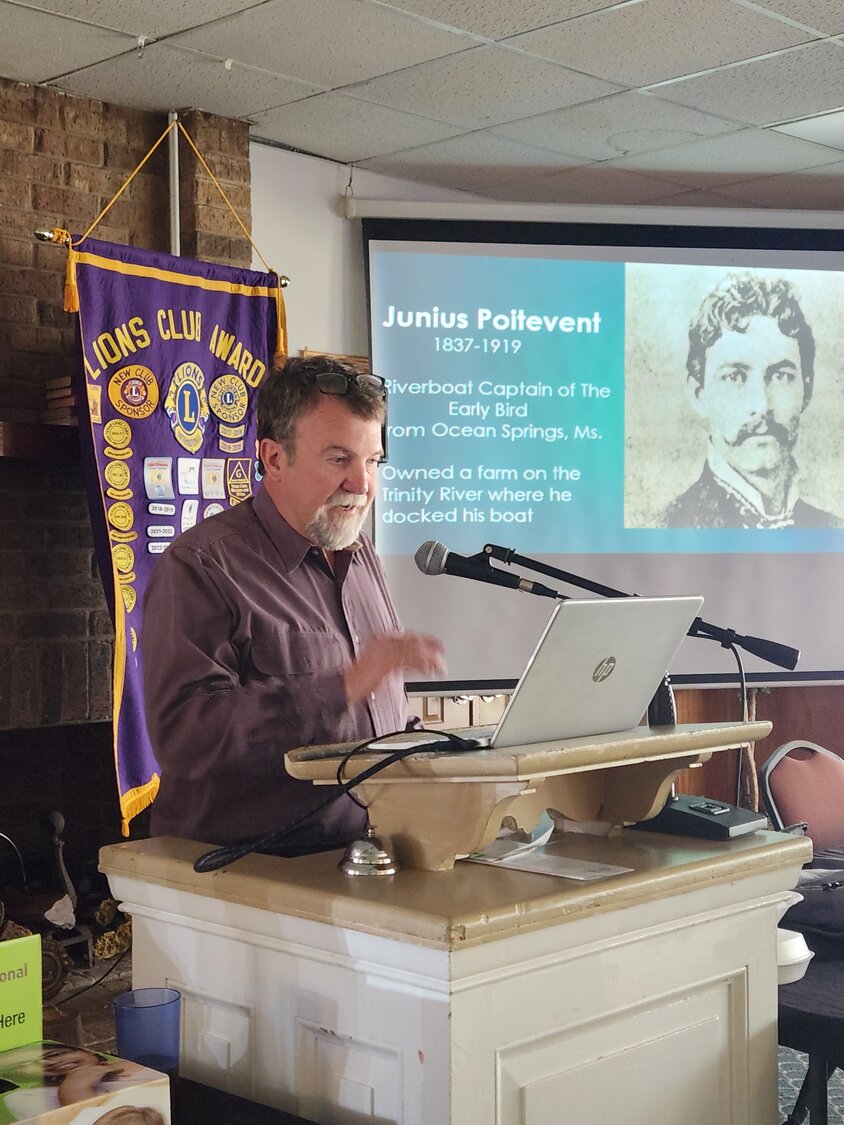
Local Historian Gary Davis presented a program for the Livingston Lions Club Wednesday in which he told about many of the pivotal and influential people from the early days of Livingston and the surrounding area.
Junius Poitevent (1837-1919) was from Ocean Springs, Miss. He owned a farm on the Trinity River and was a riverboat captain of the “Early Bird,” a 126-foot-long by 26-foot-wide boat that shipped cotton, supplies and passengers up and down the Trinity River. Poitenent eventually had 1,000 acres across the state that he earned by cleaning the Trinity River one mile at a time. Then the riverboat era gave way to the railroads about 1880.
C.A. Noblitt (1847-1912) was a civil engineer who built the first railroads in Polk County. He served as county surveyor from 1888-1890 and Noblitt Street is named for him.
Professor Marcellus Winston (1838-1913) was a teacher at the Moscow Masonic Academy that was established in 1853, a school that was considered the best in the state. He taught thousands of students from 1865-1896.
Ben M. Lewis (1872-1938) was a photographer and jeweler and often said he was a chronometric surgeon which is a fancy name for watchmaker. He was the proprietor of the Emerald Ice Cream Parlor and fielded the Emerald baseball team. He called himself “Lewis the Jeweler.”
Lewis and five other people were members of the Livingston Camera Club circa 1900, and they called their their photos cabinet cards. According to Davis, Ben Lewis was the recorder of history by taking photos.
Sidney Scarborough (1873-1910) grew up in the river bottom on a farm his father bought from Poitevent. He helped put in the city’s water system around 1914.
Professor O.H. de La Morton (1848-1918) was born in London, raised in Paris and educated in Vienna. He came to Livingston from Galveston after surviving the hurricane. He lived on Liberty Road and has a street named for him. He later ended up in Southern Mississippi, having invented a popular tailoring system.
W.L. West (1882-1975) established the Polk County Enterprise on Sept. 29, 1904. He served as the treasurer of the chamber of commerce that was established in 1914 and was also a city alderman in 1914. West was the leader of a movement to get the Shreveport Airline Highway in 1930 and upon completion, the opening was celebrated in the center of downtown Livingston. He was a real advocate, in favor of paved roads, sidewalks, water, electricity and sanitation. He had a skating rink that he turned into an opry house, which held shows that people from all over the U.S. came to see. His brother-in-law was Judge E.J. Manry (1869-1925).
Charles H. Davison (1848-1900) was an early merchant of Drew’s Landing.
C.J. Gerlach (1854-1940), another early merchant in Livingston, was the proprietor of C.J. Gerlach and Sons from 1882-1929. He was a city alderman in 1916. He came from Louisiana and Davis said the legend is that he walked here from Crockett.
His brother was L.F. Gerlach (1861-1927), one of the founders of both First National and First State banks and the telephone company. He also served as the first president of the chamber of commerce.
J.W. Cochran (1859-1934) was the proprietor of J.W. Cochran and Company which was established 1881 in Moscow and later moved to Colita. He was a co-founder of First National Bank, the telephone company, the brick company and the light company and he served as mayor from 1918-1920.
H.B. Davis (1871-1950), Davis’s great grandfather, came to Livingston in 1903 from Nacogdoches with S.P. Mistrot out of Galveston. He served 25 years on the school board and was a co-founder of the Livingston Electric Light Company. There were three generations of merchants in his family, all with the name H.B. Davis.
George F. Sawyer (1857-1920) was the proprietor of a cotton gin, gristmill, sawmill, electric plant, bottling plant, co-founder of Polk County Bank, phone company, and brick company and also played in the Livingston Orchestra. He also had a 1908 Kiblinger car.
Ernest Reuter Sr. (1891-1977) was in a western circus called the Miller Brothers Wild West Show in which he played the cornet. He left Massachusetts on a train and arrived in Livingston, Texas by mistake when he was supposed to be in Livingston, Missouri. He was a master plumber and oversaw construction of the city’s water system in 1915. He was the first fire marshal and one of the first fire chiefs. He played in the Livingston Orchestra, served in World War I and established the Hale-Sellers American Legion Hall here.
Cade Bethea (1877-1955) grew up in Seven Oaks, but his father sent him and his older brother Lamar to the University of Texas at Austin to get law degrees and they both began playing a new sport called football. Cade was a halfback and Lamar was a lineman and they both became county attorneys.
Joseph Holshausen (1849-1915) was the county surveyor from 1870-1872 and served as judge in 1878.
Theophilus F. Meece (1840-1914) served as the sheriff, district clerk and county judge and also served in the 27th legislature.
S.H. German (1874-1941) was an attorney and played on the Emerald baseball team. He served in the 31st and 32nd legislatures and had ties to the Baker & Botts Law Firm.
Pleasant Reid Rowe (1868-1936) served as county attorney, county judge and Sam Houston’s Indian Agent.
J.C. Feagin (1855-1927) was the county attorney and also served in the 24th legislature.
C.L. Carter (1869-1936), W.T. Carter’s brother, served as county attorney and district attorney and later worked for the Baker & Botts Law Firm.
Ralph B. Feagin (1891-1946) was one member of the three-person class of 1908, the first graduating class of Livingston High School. He went to the University of Texas at Austin and was the first editor of The Daily Texan.
Anson T. Feagin (1882-1942) served as an editor of the Polk County Enterprise and also served as mayor.
E.T. Murphy (1889-1960) served as the school superintendent.
Percy E. Foreman (1902-1988) was a shoeshine boy who became a famous criminal defense attorney.
J.E. Peters (1884-1941) was one of several local men who went to the state fair in Dallas and then to Fort Worth and selected 53 double-immunized Duroc pigs that were shipped by rail to Livingston for the boys and girls of Livingston to raise and sell for stock. The boys and girls signed notes with the First National Bank.


