

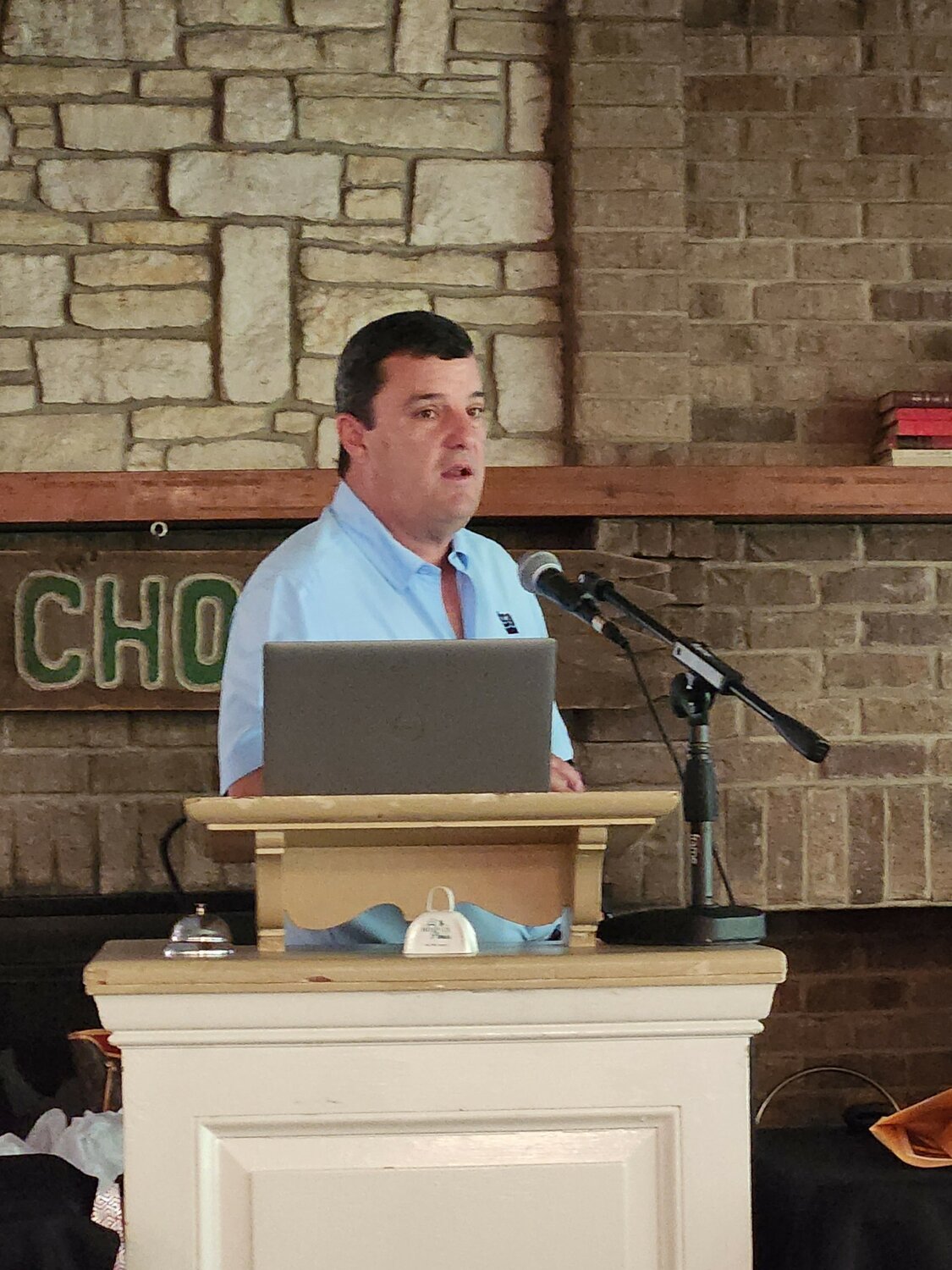
Chad Holton, project manager for the Trinity River Authority Lake Livingston Project, was the guest speaker for the Livingston-Polk County Chamber of Commerce’s Quarterly Membership Luncheon May 20 at Camp Cho-Yeh where he provided updates on the Lake Livingston Dam.
“We had lots of rain last year and the dam incurred some damage. We’ve been working on that. It is important to understand the components to fully understand what happened,” Holton said, showing a photograph taken in 1969 during construction of dam, where he pointed out the training wall, apron, wing wall and end sill.
He reviewed the addition of a weir wall in 2004 to mitigate the loss of tailwater that occurred as the result of numerous flood events that have passed through the dam.
“We were basically losing the tail water weir wall built in 2004 to contain that tail water,” he said.
“Last year was a challenging year. We had the seventh-highest release in January which was 84,800 cfs (cubic feet per second). We had a gate rehab project underway so two gates weren’t open. In February, we could shut off the water and assess the damage and we saw where the rip rap had been pushed and displaced. We didn’t have enough time to finish the project because we started getting high flows again in March so we had to pull out,” Holton said.
That led them to order more rip rap from Marble Falls and begin stockpiling it.
An all-time high record flow of 124,000 cfs was reached on May 2, 2024 and shortly after that, dam officials discovered that a piece of the wing wall had fallen off.
“It was not a dam safety issue, but it needed to be mitigated before it got worse. We called Windham & Sons and they were there within three to four hours. We didn’t know how deep of a hole we had,” he said, adding that they got a contract with Boyer Inc., a civil engineering firm out of Houston.
“On June 28 we shut off the spillway and had divers in place and learned there was about a 200-foot section of the weir wall built in 2004 that was gone and the rip rap was displaced. Water had gotten 10 feet below the end sill under gates four and five and worse, had gotten up under the apron. We found a 50-foot scour hole. We then went into emergency plan mode,” Holton said.
“By now, we’re in hurricane season and had Beryl. We took it serious. We had to do something before Beryl got here. We had an emergency center set up at the dam with both federal and state departments of emergency management, engineers, Boyer. We’re all brainstorming. What can we do to protect that end sill before Beryl gets here, which was 10 days away? A lot of things had to come together. I really think God had a hand in it,” Holton said.
“We had to build a dike to put the truck on to pump the concreate into the barges. It was crazy – like 100 trucks a day came through. We poured concrete all the way across about 20 yards out. There were lots of fish and alligator gar and we had to be mindful of that,” he said.
“We had to build another weir wall. We tried to get FEMA funds to pay for it but permanent fixes are not eligible for FEMA funds. We would’ve liked to have put rebar in it, but couldn’t because this was an emergency fix,” he said.
“We still have five gates to finish rehab on. We’re going to to create a computerized model to see what would be the best way to make improvements that will occur probably within the next five years.”
In closing, Holton said the two gates out of service were actually the cause of the damages.
“I’ve never seen anything like it, to have so many people working together,” Holton said.


