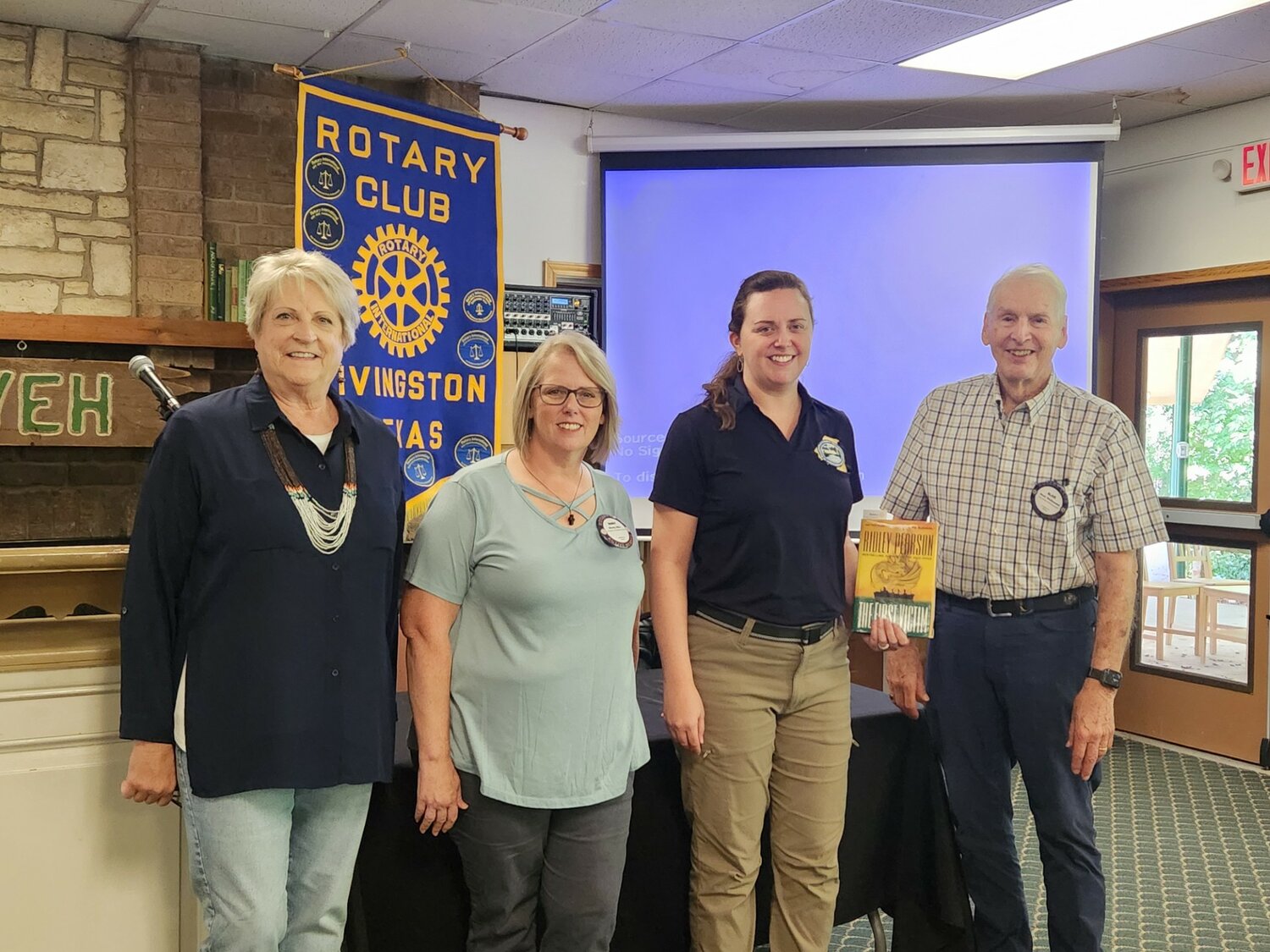
Polk County Emergency Management Coordinator Courtney Comstock provided a program for the Rotary Club of Livingston Thursday.
“The Polk County Office of Emergency Management is responsible for emergency preparation, response, recovery, mitigation, overseeing and updating the county emergency plan and working with our response agencies throughout the county,” Comstock said. “We work behind the scenes preparing for the next disaster. We’re trying to make this community better prepared and more resilient.
“Hurricane Season is June 1 through Nov. 30,” Comstock said as she shared Polk County’s vulnerability during Hurricane Season.
“Polk County is located a little over 100 miles inland. It is not affected by storm surge. However, torrential rains, tornados and high winds can result from hurricanes and cause damage to life and property. Heavy rains produced by a hurricane can cause flash flooding and flooding near the Trinity and Neches Rivers,” she said.
Comstock reviewed the Saffir-Simpson Hurricane Scale. Category 1 is 74-95 mile per hour (mph) winds causing minimal damage such as unanchored mobile homes, vegetation and signs. Category 2 is 96-110 mph winds with moderate damage such as all mobile homes, roofs, small crafts. Category 3 is 111-130 mph winds with extensive damage such as small buildings, homes impacted, low-lying roads cut off. Category 4 is 131-155 mph winds with extreme damage such as roofs destroyed, trees down, roads cut off, homes impacted or destroyed, mobile homes destroyed. Category 5 is winds more than 155 mph with catastrophic damage such as most buildings destroyed, major roads cut off, homes destroyed and flooded.
“Category 3 or higher is considered a major hurricane,” Comstock said, adding that in the days leading up to a hurricane, her office looks at wind probability and estimates damage.
She reviewed a history of hurricanes and tropical storms in Polk County, some of which brought wind and some of which brought rainfall. These included: Hurricane Jerry on Oct. 15, 1989 which was a Category 1; Tropical Storm Frances on Sept. 11, 1998; Tropical Storm Allison on June 5, 2001; Hurricane Rita on Sept. 24, 2005 which was a Category 3; Hurricane Humberto on Sept. 13, 2007 which was a Category 1; Hurricane Ike on Sept. 13, 2008 which was a Category 2; Hurricane Harvey on Aug. 25, 2017 which was a Category 4; Hurricane Laura on Aug. 27, 2020 which was a Category 4; and Hurricane Beryl on July 8, 2024 which was a Category 1.
Comstock said that locations across Southeast Texas spent nearly three weeks in the forecast cone during the 2020 tropical season.
“There have been 10 major hurricane landfalls in Texas since 1960. Most hurricane/tropical storms develop or rapidly intensify over the Gulf. There is not much time between formation and landfall for Gulf developers, so we need to be prepared to accelerate timelines. Of the nine tropical cyclones to impact Texas since 2010, only one developed outside of the Gulf and that one redeveloped rapidly,” Comstock said.
The 2025 Atlantic Hurricane Season Outlook was updated on Aug. 7. As for season probability, she said it reflects 50% above normal, 35% near normal and 15% below normal. The outlook predicts 13-18 named storms, five to nine hurricanes and two to five major hurricanes.
Comstock stressed the importance of every family/residence having a hurricane preparedness disaster supply kit to last for 72 hours. The kit should include: water, one gallon of water per person per day for at least three days, for drinking and sanitation; food, at least a three-day supply or non-perishable food; battery-powered or hand crank radio and a NOAA weather radio with tone alert and extra batteries for both; flashlight and extra batteries; first aid kit; whistle to signal for help; toilet paper and moist towelettes, garbage bags and plastic ties for personal sanitation; wrench or pliers to turn off utilities; non-electric can opener for food (if kit contains canned food); emergency reference material such as a first aid book or information from www.ready.gov.
She said additional items to consider include: prescription medications and glasses; infant formula and diapers; pet food and extra water for your pet; important family documents such as copies of insurance policies, identification and bank account records in a waterproof container; cash and change; sleeping bag or warm blanket for each person; fire extinguisher; and matches in a waterproof container.
Comstock encouraged anyone with medical, functional and access needs or transportation needs to register with the State of Texas Emergency Assistance Registry (STEAR). It is a free
registry that provides local emergency management planners and responders with information related to your needs during an emergency. Those who should register include: people with disabilities; people who are medically fragile; and people with functional needs such as limited mobility or communication barriers. One may register online at stear.tdem.texas.gov or by calling 2-1-1.
A checklist for these people includes: medical equipment and assistive devices; a list of model numbers or serial numbers of medical devices and equipment; medical alert tags or bracelets; medications and copies of all prescriptions; hygiene supplies; phone numbers and names of physicians; and supplies for service animals.
Regarding evacuations, Comstock said state law provides a county judge or mayor with the authority to order evacuation of all or part of the population from a stricken or threatened area within their respective jurisdictions.
“The county judge, or mayor, has the general responsibility for recommending evacuation when that is the most suitable means of protecting the public from a hazard. The county judge, or mayor, may also take subsequent action to control re-entry, curtail movement and deny building occupancy within a disaster area,” Comstock said.