

In the never-ending battle against road deterioration, county commissioners are often looking for new ways to save taxpayer funds.
Many roads in Polk County are dirt, gravel or chip and seal. The biggest drawback from any of these is the frequent repairs and maintenance required for proper upkeep.
That is what had Polk County Precinct 1 Commissioner Guylene Robertson looking for an alternative solution.
“It is not necessarily the cheapest (that we are looking for), but the best at this price,” Robertson said. “We want the best that we can possibly afford that will last the longest for a good road surface. Every commissioner is concerned about the roads for their constituents.”
Robertson said she was able to find a few alternatives through state trainings and further research. That is where she came across Rankin Industries from Roanoke, Texas, that was established around seven years ago. Owner Lance Rankin said his product, an eco-friendly road glue, can help reduce dust while boosting strength and durability of country roads.
“The best thing that can be done on any road is for a concrete road to be installed. It is multi-millions of dollars,” Rankin said. “The next best thing to be done is a nice asphalt road. Again, it is millions of dollars. The third choice is this road glue. It is much more economical than asphalt or concrete.”
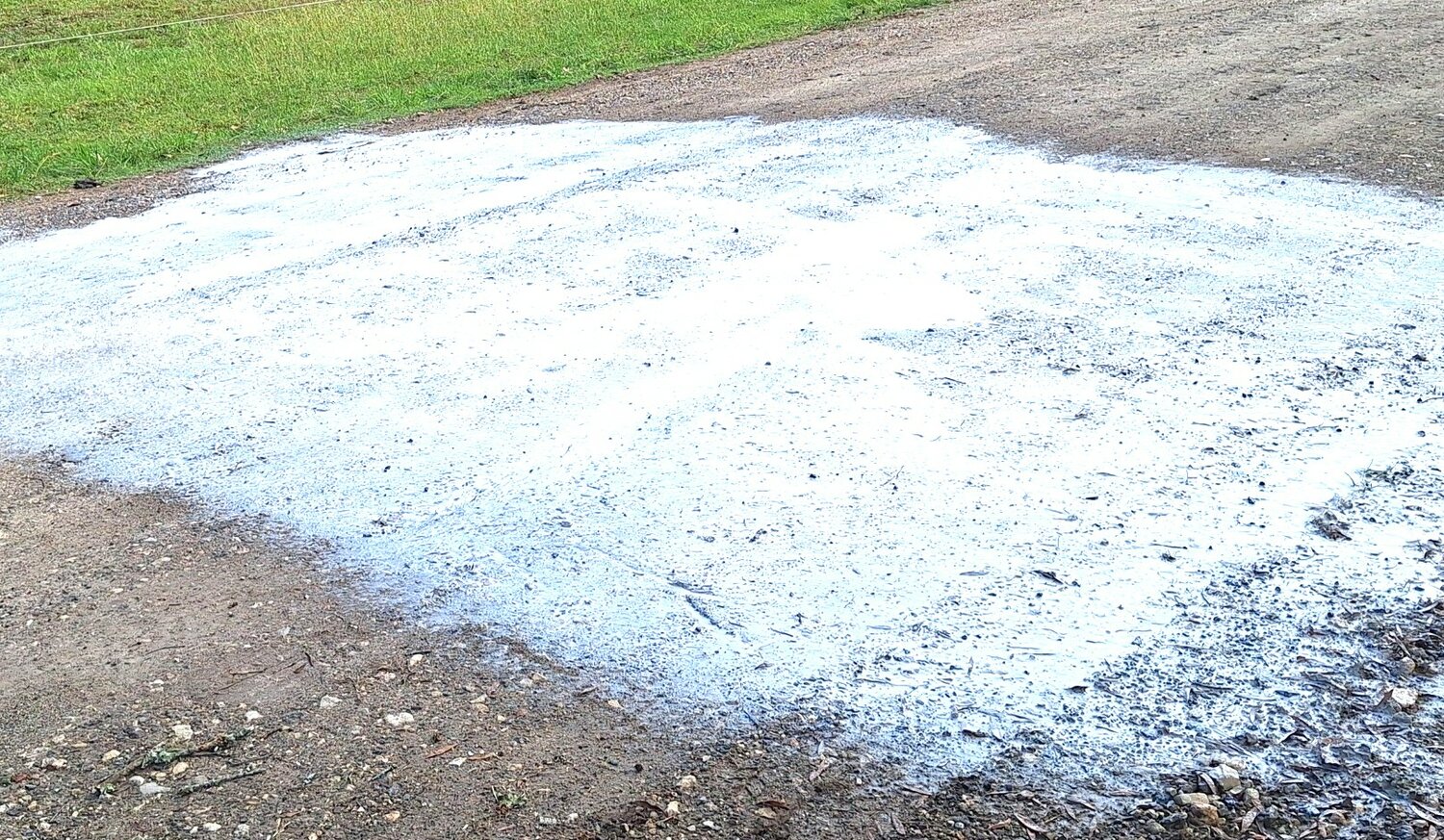
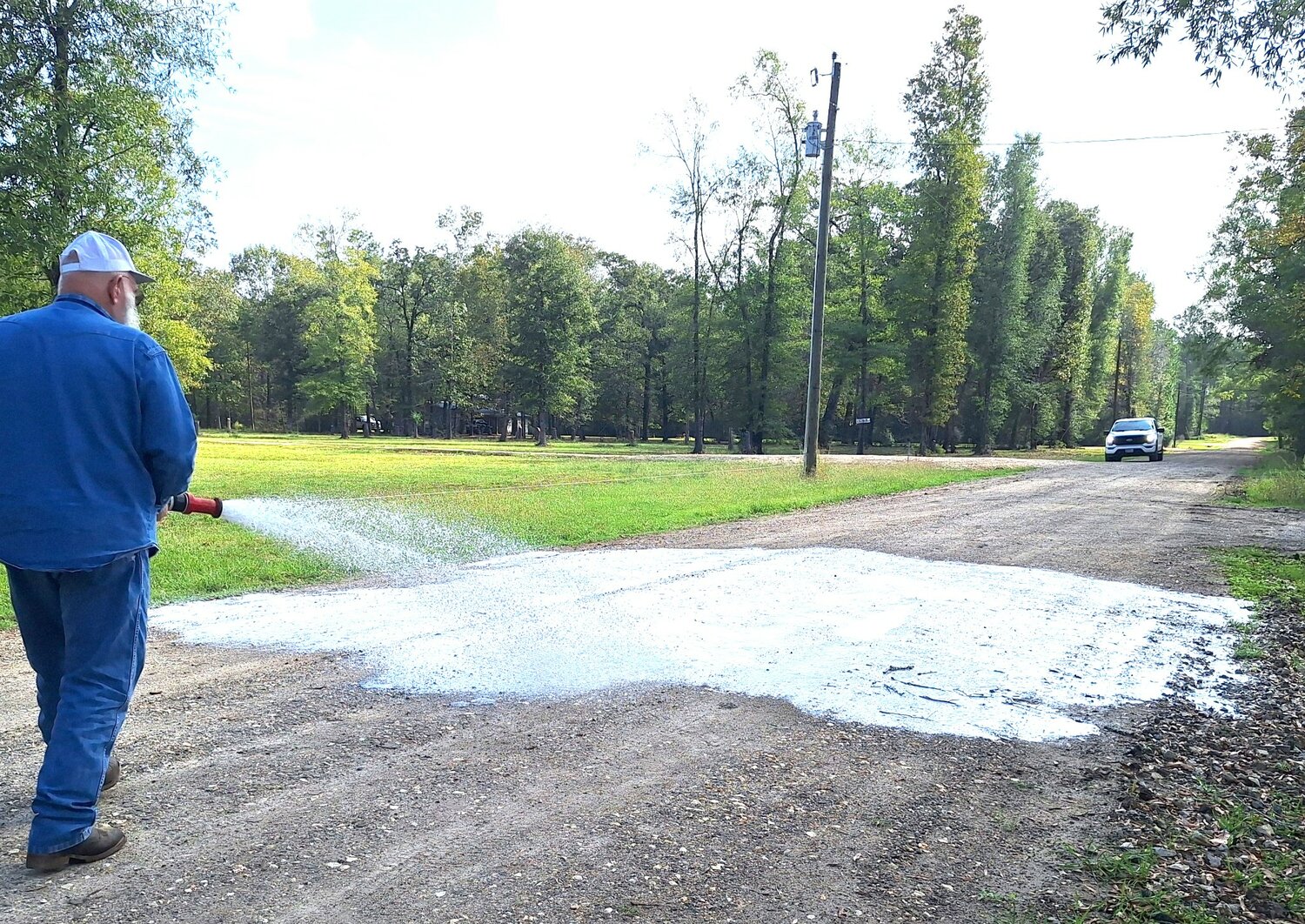
Rankin demonstrated his road glue product at a few different locations within Polk County last week. The product is said to dry to a solid surface within 24 hours, but completely cures within 30 days. It can be driven upon immediately and Rankin said it is not a sticky glue that will cling to tires, throwing gravel or adhesive into a wheel well.
“The product is an eco-friendly glue. The way this came about was many years ago; the military developed it,” he said. “They sprayed it down on the sand in Afghanistan to make runways out in the desert. After that, lots of guys in the military came back and thought that this was a commercial-ready product. There are several companies that do something similar, but just like anything, they water it down and mass-market it. It has kind of, in my view, damaged the industry a little bit. It is just somebody out there trying to make a quick buck. What we have done is got with the manufacturer for our brand. It is a proprietary product, and we have made certain that the active ingredients are at the highest possible levels, so that when people buy a tote of this stuff, it is going to mix with water and go a long way and do what it is supposed to do.”
So what is it supposed to do?
One of the bigger purposes is dust prevention. After visiting a few of the sites Monday, cars driving by on dirt roads would kick up dust in certain spots, but not where the road glue had been applied. Another function is strengthening the area, while making it more durable to withstand traffic. The road glue makes dirt roads dense, creating a hard surface once it completely dries. It is water impenetrable and keeps gravel and fine sands in place. Many of the potholes that develop will take much longer to do so. Rankin said something like a bulldozer or skid steer can go over and scuff the surface, but the repair is much easier than without the road glue in place.
His regular customers are residential areas with driveways, ranches, or even a runway. Yet, Rankin said the concentrated product can be sold with a demonstration on how it is mixed and applied, allowing county employees to do so.
“Whenever people start talking about glue, this is more on the end of like Elmer's glue that we had as kids,” he said. “A lot of people think it's going to be this toxic glue, and it's not. It is eco-friendly and non-toxic. Once it is all watered down and mixed correctly, there's really no smell. It has a white, milky look to it.
“If you've got a highway and you've got hundreds of cars going over it with heavy 18-wheelers, you are going to have to spend the money and put in a concrete highway or asphalt. If you are looking for something that is more friendly to the budget, then this eco-glue is the answer. People use it for dust, but it's really to strengthen and make the roads last longer. There's not as much upkeep and maintenance.”
The product can be sprayed on top of a dirt, gravel or chip and seal surface, or mixed in when creating the roads. Rankin said the product’s durability depends on the amount of traffic and heavy vehicles that travel across it.
“I tell everybody to expect a year out of this stuff. I've got a road in Oklahoma that we did five years ago, and it is still there with not one problem. I can still drive 55 mph on it with no dust. There is hardly ever an 18-wheeler or loaded down piece of machinery on it. I would say that road probably gets 20 cars a day. That was a one-time install and nothing else. What we suggest is once a year, do a quick pass over it, just spraying a quick coating of this down. It will put an extra layer on there and over the years, that builds up and creates a thicker, hard surface.”
If the county were to purchase the product, they would receive it in a 275-gallon tote of pure concentrate. The concentrate is made in two different strengths. The one demonstrated last week would cover a 20-foot-wide road for a length of 275-400 feet. Rankin said the price comes out to around 36 cents per square foot.
“It will save them on manpower and equipment use, and it will make things last longer when they do repairs,” Rankin said. “It is a permanent glue seal that sets everything to where your gravel doesn't throw. That gravel is not moving, and it is staying there in place, so you don't have to come and refill it.
“We are honored to help the county keep its roads in top shape while staying easy on both the budget and the environment. (It) provides a smart, safe option for our land and our people. It’s a privilege to be part of this solution.”