

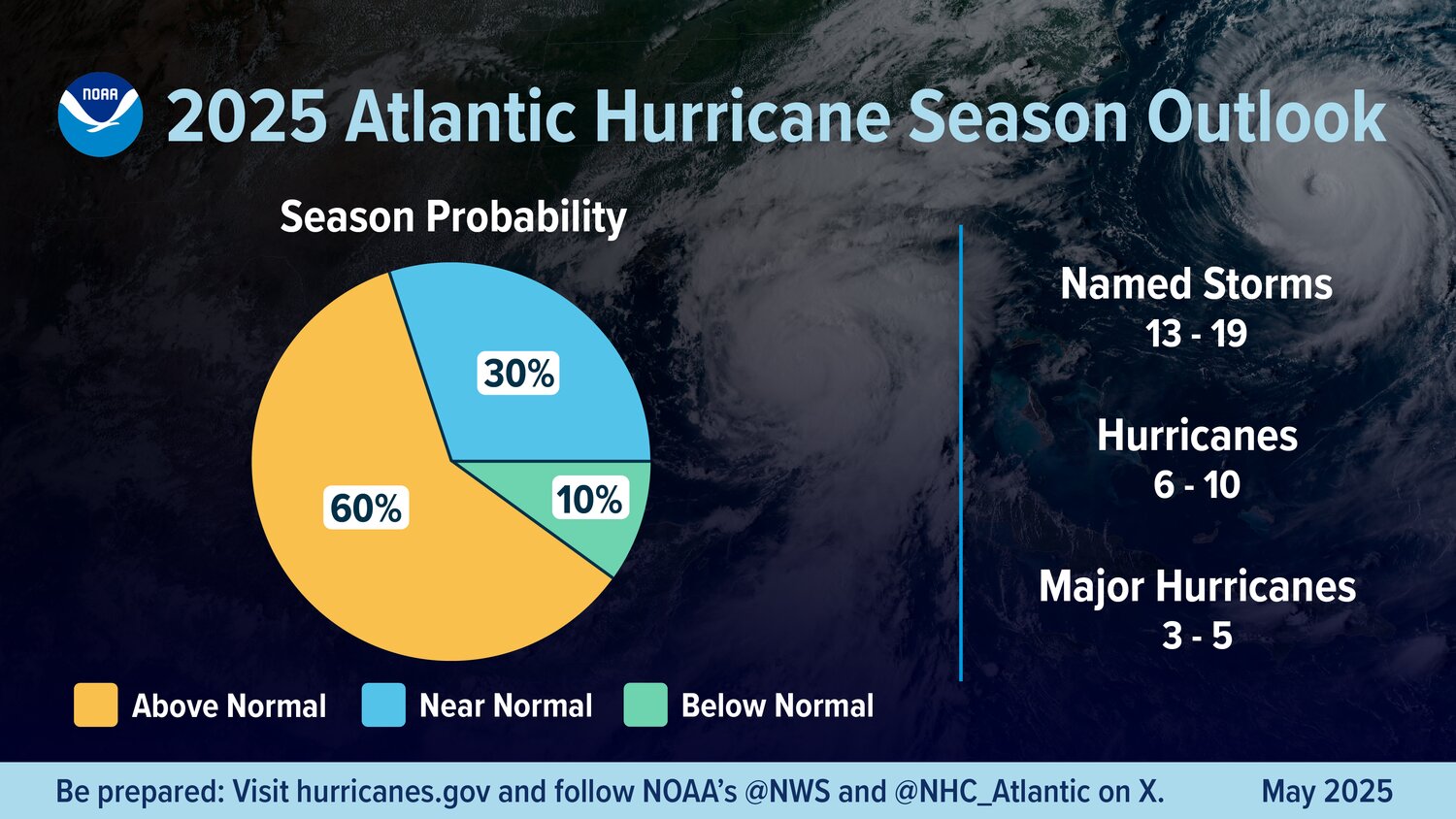
For the second year in a row, the National Oceanic and Atmospheric Administration (NOAA) is predicting an above-normal hurricane season.
The NOAA’s National Weather Service released its predictions on the Atlantic Hurricane Season last Thursday, which begins on June 1 and lasts until Nov. 30, and overall predicts a 60% above-normal season and a 30% chance at a near-normal season.
Comparatively, the agency predicts a near-normal season for tropical cyclones for the Pacific Hurricane Season, with a predicted 1-4 cyclones.
NOAA is forecasting a range of 13 to 19 named storms this season, with winds of 39 mph or higher. Of those, according to NOAA, 6-10 could become hurricanes (which are storms with winds clocked at 74 mph or higher), including 3-5 major hurricanes, with winds of 111 mph or higher, and the agency stated in its news release to share predictions it is 70% confident in its predictions.
NOAA, which operates under the United States Department of Commerce utilizes “the most advanced weather models and cutting-edge hurricane tracking systems to provide Americans with real-time storm forecasts and warnings,” said U.S. Commerce Secretary Howard Lutnick.
Lutnick added that the technology at NOAA’s disposal creates predictions that make Americans more prepared for hurricane season than ever before.
Here in Texas, Gov. Greg Abbott proclaimed this week to be “Hurricane Preparedness Week,” which he said is set aside to raise awareness of the dangers of hurricanes and the precautions Texans can take as the season approaches.
“The State of Texas knows all too well the devastating power of hurricanes,” Abbott said. “From storm surges to high winds, hurricanes pose a threat to life and property. This Hurricane Preparedness Week, it is crucial that every family, business, and community take proactive measures and stock up on emergency supplies to protect themselves, their loved ones, and their property as hurricane season approaches. By taking the time now to prepare for any devastating and powerful storms that may reach our shores, we can help foster a safer and more secure future for our state.”
Acting NOAA Administrator Laura Grimm said that last year’s “significant inland flooding” resulting from hurricanes Helene and Debby demonstrate the impacts of hurricanes “far beyond coastal communities.”
“NOAA is critical for the delivery of early and accurate forecasts and warnings, and provides the scientific expertise needed to save lives and property,” she said.
State officials with the Texas Division of Emergency Management (TDEM) have reviewed the appropriate planning documents to ensure communities’ needs in the event of a hurricane, and have held its annual hurricane exercise, which included partners from all levels of government, as well as the private sector.
Multitude of factors
According to NOAA predictions, a confluence of factors are to blame for an above-normal expected season for hurricanes.
Warmer-than-average ocean temperatures, as well as forecasts for a weak wind shear and potential for higher activity from the West African Monsoon, which is a primary starting point for all Atlantic hurricanes, are possible factorsm according to NOAA.
“In my 30 years at the National Weather Service, we’ve never had more advanced models and warning systems in place to monitor the weather,” said NOAA’s National Weather Service Director Ken Graham. “This outlook is a call to action: be prepared. Take proactive steps now to make a plan and gather supplies to ensure you're ready before a storm threatens."


